
Staff Augmentation vs. Outsourcing: Complete Guide
Compare staff augmentation vs outsourcing, understand key differences, and choose the right model to scale your team efficiently. Learn more.
A club's inventory now competes on whether external platforms can read and book it, not only on whether its own website converts.
Last updated: September 2026 · By Matías Fuster, CEO at Solcre
Bottom line. Booking is no longer the last step of a funnel that a club controls. Interfaces like Google Search, Maps and ChatGPT are absorbing the transaction itself, so a club's inventory now competes on whether external platforms can read and book it, not only on whether its own website converts. For teams building booking software, that turns the integration surface into something that needs as much design attention as the screens.
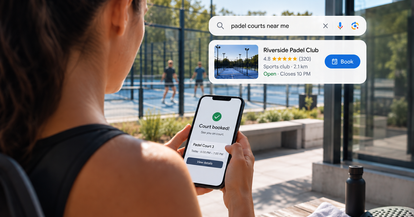
The sports booking distribution problem is the gap between a court being free and a court being bookable from wherever the player expressed intent. When discovery and transaction happen inside a search engine, a map or an AI assistant, availability that exists only inside a club's own interface cannot be sold there. Availability becomes a form of distribution.
Google already lets users book certain services and fitness activities directly from Search and Maps through booking providers, a capability it documents under Reserve with Google. ChatGPT can surface real-time restaurant availability from providers such as OpenTable, Resy and Yelp, and in supported experiences it can take users straight into the reservation flow. When intent is high, the distance between finding and booking shrinks.
The behavioral change is broader than restaurants. Instead of asking "What sports clubs are near me?", a user can state the whole intent at once:
"Find me an indoor court within 15 minutes, tomorrow after 7 PM, for four players, under $60."
Conversational search is only the visible part. The change is in what the interface can do after it answers. If it understands availability, price, location and booking rules, discovery turns into a transaction.
A court that is technically available but that no external platform can read is, from the player's point of view, close to invisible.
Booking software used to be operational. It handled schedules, memberships, payments and court utilization after a customer had already found the club. Once that inventory can appear at the point of discovery, the same software decides where inventory is visible, which users can access it, how much friction stands between a user and a purchase, whether external platforms can understand the availability, and whether demand can be traced back to its source. Those are growth questions as much as operational ones.
In vertical SaaS, a booking product has usually been defined by its user interface, with APIs, webhooks and data schemas specified once the core experience was settled. That framing is now backwards. When Google, an AI assistant, a marketplace aggregator or a partner app can consume the inventory, those systems are users of the platform in the same sense that human players are. A backlog that only asks what the player does inside the interface is missing half the product.
An operator asking for a booking system usually needs a booking API with an operator dashboard, where the web app is one delivery channel among several rather than the product definition itself. Asking that question during scoping, and shaping the data model around the answer, separates a platform that can participate in the emerging distribution layer from one that has to be rebuilt the day the operator asks why their inventory isn't showing up anywhere.
Product ownership has always meant representing future use ahead of present convenience. In sports tech, that future use increasingly arrives through channels the operator does not control.
Of the nine digital product projects Solcre started in 2026, eight arrived with an MCP server already in the defined scope. Count every digital product we quoted this year, confirmed or not, and roughly three quarters listed one in the requirements. The decision described above reaches us from the client side now: their requirements cover their users' flows and what an external agent will be able to do with the system.
The most valuable sports platforms may end up as distribution layers for sports inventory rather than reservation managers. The advantage would go to whoever makes that inventory easiest to find, understand and book from anywhere: search engines today, marketplaces and partner apps tomorrow, AI agents acting on behalf of users after that. For the player, booking may stop starting with an app and start with saying what they want to play.
Google supports booking certain services and fitness activities from Search and Maps through booking providers. ChatGPT supports real-time restaurant availability from providers such as OpenTable, Resy and Yelp, and in supported experiences it can move users into the reservation flow. The mechanism exists, and how far it reaches into sports depends on which booking providers expose their inventory.
No. It means the website stops being the only place where the booking can happen. A club's digital competitiveness depends on how well its site converts and on whether its inventory can be discovered and booked somewhere else.
A booking system is usually scoped as an interface: flows for the player and a back office for the operator. A booking API treats availability as a resource any authorized channel can query and transact against, with the web app as one of those channels.
The product owner, at scoping time. Modeling availability as a queryable resource shapes the data model, and retrofitting it later is a rebuild rather than a feature.
Compare staff augmentation vs outsourcing, understand key differences, and choose the right model to scale your team efficiently. Learn more.

E-commerce evolves very quickly, and so do digital consumers' spending habits.

In this article we'll share five important upsides that could tip the scales in favor of developing custom software.
How can we help you take your idea to the next level?
Let’s talkContact us
Get in touch.